| NGO Role More Valuable than
Ever
A joint annual consultative meeting on partnership and policy
with regards to ODA between NGO representatives and the Ministry
of Foreign Affairs (MOFA) was held on 2nd June at MOFA to
strengthen communication and understanding.
Participants included Mitsuhiro Saotome, Ambassador for Civil
Society, Special Assistant to MOFA, Nobuki Sugita, Deputy
Director-General, Economic Cooperation Bureau (ECB), and Shigemi
Jomori, Director, NGO Assistance Division, ECB, MOFA. NGO
representatives included Yoshitake Funato, Chair, and Hideyuki
Takahashi, Vice-Chair, JANIC, and Director, Resource Development
and Campaign, JOICFP.

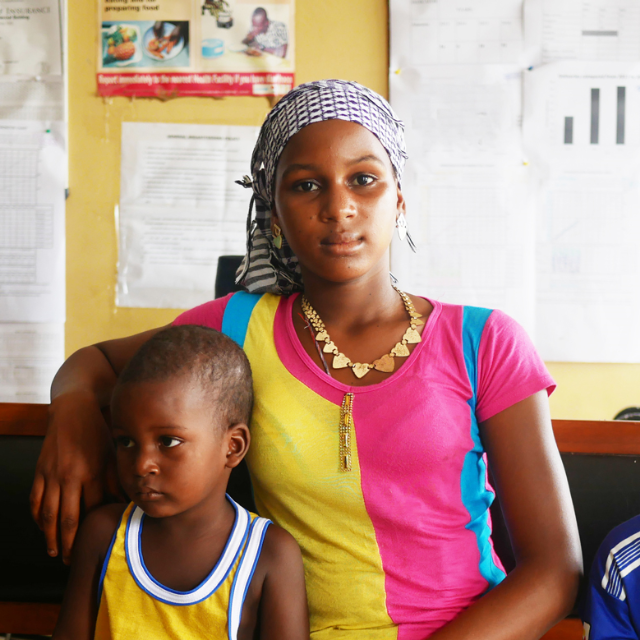
A mother
caring for two babies in Tanzania
In a presentation to the meeting, Takahashi said that although
the trend was of declining ODA, this need not be thought of
as negative by NGOs as there was now a bigger role for them
to play, especially in delivering effective assistance to
those who need it most at the grassroots level.
Takahashi explained that at current levels of commitment,
it seemed unlikely that the internationally agreed MDGs
would be attained by the target year of 2015. This was based
on observations at the grassroots, where little ODA reaches
those in need; women and children. Existing channels of administering
ODA are inadequate, he said.
If the eight MDGs are to be achieved, policies and practices
must be reviewed and cooperation with NGOs increased to effectively
use shrinking resources, he emphasized. Furthermore, NGO participation
in developing countries fosters civil society, thereby strengthening
sustainability through community participation and ownership.

Weighing newborn
babies at a community health post in Indonesia.
At present, less than 2% of Japanese ODA goes through NGOs.
Compared with the average of 0.33% of Gross National Income
(GNI) for ODA in 22 OECD DACs (development assistance committees),
Japanese ODA still ranks 17th, Takahashi stated, so there
is room for great expansion in future.
On the surface, it seems that Japanese ODA has been increasing
as in 2005 Japanese ODA accounted for US$13.1 billion out
of a total from the 22 DACs of US$106.4 billion. However,
Takahashi explained, 46.8% of Japan's ODA increase with US$4.18
billion had been debt relief for highly indebted countries,
including a large amount for Iraq and Nigeria.
Raising awareness
Takahashi stressed that ODA came from taxpayers, but in most
cases they had little idea how their taxes were making a difference
to the lives of people in developing countries. The Human
Security Grassroots Grant Assistance administered by Japanese
embassies is highly regarded, but its comprehensive and actual
activities remain unknown, he said. Japanese NGOs could collect
and provide information to the public, thereby meeting the
requirements for ODA accountability, he stated, and this would
also encourage all concerned.
The comparatively higher rate of ODA from developed countries
that goes through NGOs is for those who are actually in the
field, but NGOs in developing countries are building their
capacity and are becoming more able, he said. What are needed
are policy and mechanism changes to support partnership between
Japanese NGOs and local NGOs in developing countries, he explained.

Provding a fruit tree
nursery for peasant farmers in Afghanistan
Takahashi finished by saying that although these issues were
not new, now more than ever the role of NGOs must be increased,
and that network NGOs could play a greater role in raising
awareness, building NGO capacity, and in advocacy.
|