| Unforgettable Mothers
Some images remain in my memory for a long time, and in conjunction
with Mother's Day, some women will be recalled.
February 1988: In a village near Hanoi, Vietnam
Vietnam 18 years ago was so impoverished that we could never
imagine it from the present conditions of the country. There
were rarely houses that had electric lights, not to mention
street lamps, even in the capital city Hanoi. People in Hanoi
had to work four different jobs to fill their stomachs every
day. Some were engaged in domestic piecework.
I visited a village in the suburbs of Hanoi. It was still
cold in northern Vietnam in February, but there was no heating,
as a matter of course. The soil in the farmland was brown
after harvesting. Next to the farmland was a woman in thin
clothes and in bare feet crouching to look at something in
her hand. When I asked my escort what she was doing, she said
that the woman had a thirst for letters and was reading whatever
she found, not caring about what was written. She just wanted
something to read. She might have been exhausted working hard
from morning until late at night with household chores, raising
children and farming. Yet, she had a zeal for reading.
It was well known that Vietnamese were enthusiastic about
providing their children with education, but this mother also
was eager to enhance her own ability. At the sight of this
enthusiastic woman, I felt confident about the future development
of this country, even though it suffered from extreme poverty
at that time.
February 1997: A village at 300 km south from Hanoi
Ona visit to Vietnam nine years after my first,people had managed to escape from extreme poverty and were
no longer worried about their meals for the day.
I visited an old woman living alone in a farmhouse. It was
a half-collapsing house with two earthen-floored rooms. Her
husband had died when he was young, and she had raised three
sons who were already adults working in Hanoi. The first son
was a doctor working in a state-run hospital, the second son
was an elite government officer, and the youngest son was
teaching at a state university. The way she talked about her
sons, proudly puffing out her chest made her look like a different
person from the image of a solitary, thin old woman. She did
not feel lonely living alone, and she was proud of her sons
who had become professionals. She had gone through hardships,
but would like to live the same life if she were to have been
reborn.
To my final question on what was her number one pleasure,
she instantly replied, "My sons will be home with their
families for the New Year holiday."
February 2006: A village in the Awasa district in southern
Ethiopia
The young mother replied to our questions in an interview,
with a happy smiling face, holding her baby born last year
in her arms. The mother is 15 years old. As she has never
been to school, she cannot read or write. Getting up around
six in the morning, she fixes breakfast, takes care of domestic
animals while taking care of the baby, and sends her husband
to work. While he is at work, she tends the coffee trees and
other cash crops around their house, in addition to household
work and childcare. She sometimes visits markets nearby. The
saddest thing is that her grandmother died, and the happiest
thing is that her baby was born. The 15-year old mother looked
carefree as she talked.
In many developing countries, however, young women die one
after another because of pregnancies and childbirths when
too young. Deliveries at young ages when women have not physically
matured tend to take many hours and they go through a difficult
labor. As a result, young women in Africa suffer from fistula,
which often makes them ostracized from their communities and
even families, and they live in misery for the rest of their
lives. This Ethiopian mother who has overcome too early pregnancy
and childbirth safely is a fortunate woman.

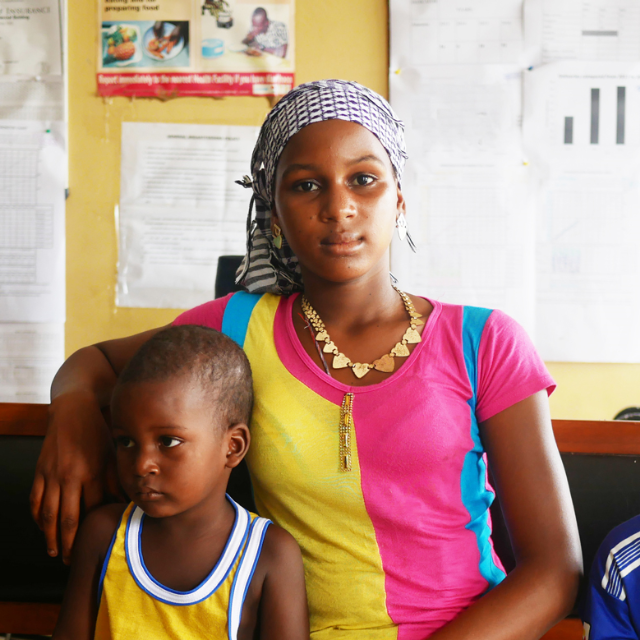
Mothers like this Masai woman in Tanzania are the ones
JOICFP wants to help be healthy and happy
There are infinite episodes of mothers who show affection
toward their children. On the other hand, there are many mothers
who lose their lives to deliver their children. One woman
dies per minute in the world because of pregnancy or delivery.
Many of these deaths occur in developing countries, and most
of these kind of deaths can be avoided in Japan. When mothers die,
many of their babies also die, or some are born, leaving fathers
bewildered to have infants without mothers at the time of
coming into this world.
On the occasion of Mother's Day, we give our thought to the
mothers who have passed away in developing countries in the
past year, and use this feeling of regret that we could not
save their lives as a springboard to continue our work to
save even one more life than the previous year. With this
determination, we celebrate Mother's Day every year.
Sumie Ishii, Executive Director, JOICFP
|