Community Initiative
for Sustaining RH Promotion in Cambodia
From 2000 to 2003, JOICFP in collaboration with the National
Center for Health Promotion (NCHP), Ministry of Health, operated
a model project in Cambodia under the UNFPA-supported Asia
Regional Project, "Strengthening of National Capacities
for RH/BCC through Community-based RH/FP Programs" (RAS/00/P06).
Even one year after project assistance from outside ended
the project is still continuing, and from 24th to 29th January,
Kei Yoshidome, Program Officer, JOICFP, visited the Put Sar
Commune, Bati Operational District, Takeo Province, to observe
project results, how it has been sustained and what motivates
health personnel and community people.
Health Center
The chief of the Health Center (HC) explained activities
carried out in 2004, highlighting that over 220 babies had
been delivered there compared to 18 in 2003. Furthermore,
the number of women taking antenatal care (ANC) had increased
by four-fold to nearly 180 in the same period. He identified
four main reasons for the success of the center: a clear fee-charging
system; 24-hour service; good teamwork among health center
staff; and close cooperation among HC staff, community leaders
and the community.

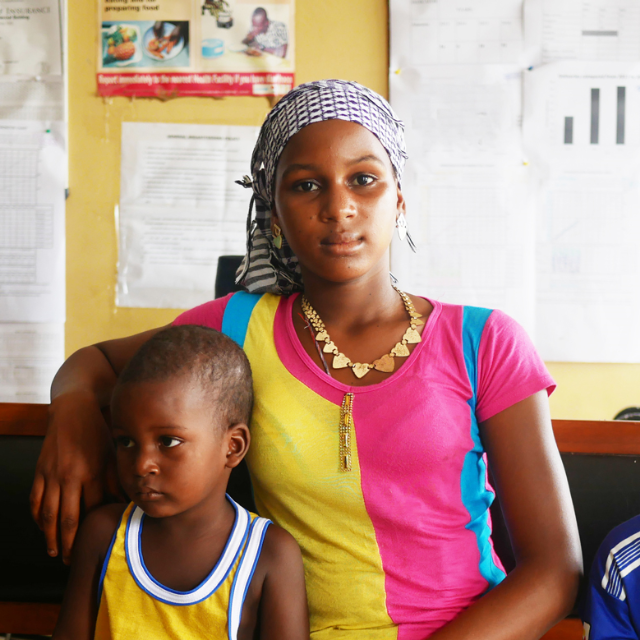
Two of the beneficiaries of the Health
Center
The activities at the HC have been so well received that
clients have been disseminating information themselves, which
has even led to people outside the HC catchment area visiting
it. Also, Yoshidome learned that necessary cases were being
referred to hospital, highlighting effective cooperation among
the health center, local authorities and village health volunteers.
The HC chief explained that no monetary incentive was paid
to volunteers, instead they received a fee-charging exemption
at the center.
The Heath Center hires an experienced and locally known traditional
birth attendant (TBA), and collaboration between midwives
and the TBA creates an atmosphere of trust and comfort for
pregnant women to use the center for delivery. Further recommendation
came from a midwife who said that she used to perform deliveries
at her home but now used the HC in order to help promote it.

Health Center staff
Speaking with a village chief and health volunteers, Yoshidome
found that most volunteers stay with the project, and conduct
health promotion outreach activities on, for example, ANC,
birth-spacing, dengue fever and diarrhea. The volunteers were
grateful that Japan had come to Cambodia to promote community
health, and they felt that it was now Cambodia's turn to respond
by promoting health themselves.
Due to a lack of funds, the community-operated monitoring
(COM) system has not been operationalized. However, all parties
concerned recognize the usefulness of the data board and are
discussing how to restart its use.

A village chief and health volunteer
Model site
A NCHP member explained how the Put Sar HC, as well as other
villages covered under the project, was used for participatory
evaluation training, organized in cooperation with the Asia
Health Institute, a Japan-based NGO.
In addition, a local NGO has is planning to organize a study
tour at Put Sar to learn about community networking for health
promotion and sustainability, after one of its members had
received training at Put Sar.
|